I will be writing a series of posts on what I like to call Iraq War Mythology. The purpose of these posts will be to tackle common misconceptions, or myths, about the war in Iraq. I hope to take on these issues in a comprehensive but thoughtful manner. My goal is to find the facts and refute the myths.
In this post I will tackle what is perhaps the greatest myth of the Iraq War: Saddam had no Weapons of Mass Destruction. The WMD issue is a hotly contested issue with strong points to be made on both sides. We have all heard Bush's political opponents and the press constantly declare: Saddam had no WMDs. The argument which follows is that Bush lied or misled the American people into supporting an unnecessary war; a war against a nation which did not attack us and which had nothing to do with 9/11 or the war on terror. For the sake of refuting the WMD myth, I will try to focus only on the issue of whether Saddam did in fact have WMDs.
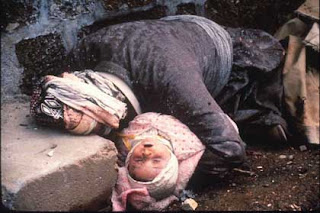
To start, we do know that Saddam did have Weapons of Mass Destruction, primarily chemical weapons, which he used routinely during his bloody reign. He used WMDs against his
enemies and he used WMDs against his own people.
Saddam Hussein was proud of his use of chemical weapons against Iranians. During his trial by the Iraqi government, Saddam said he would take responsibility "
with honor" for his use of WMDs against Iranians during the Iran-Iraq War. The Iraq Survey Group listed the following examples of Iraq's known uses of chemical weapons:
Examples of Known Iraqi Use of CW
The war with Iran ended in August 1988. By this time, seven UN specialist missions had documented repeated use of chemicals in the war. According to Iraq, it consumed almost 19,500 chemical bombs, over 54,000 chemical artillery shells and 27,000 short-range chemical rockets between 1983 and 1988. Iraq declared it consumed about 1,800 tons of mustard gas, 140 tons of Tabun, and over 600 tons of Sarin. Almost two-thirds of the CW weapons were used in the last 18 months of the war. Examples of CW use by Iraq:
Use in Iran-Iraq war, 1983-1988
August 1983 Haij Umran
Mustard , fewer than 100 Iranian/Kurdish casualties
October-November 1983 Panjwin
Mustard, 3,000 Iranian/Kurdish casualties
February-March 1984 Majnoon Island
Mustard, 2,500 Iranian casualties
March 1984 al-Basrah
Tabun, 50-100 Iranian casualties
March 1985 Hawizah Marsh
Mustard & Tabun, 3,000 Iranian casualties
February 1986 al-Faw
Mustard & Tabun, 8,000 to 10,000 Iranian casualties
December 1986 Um ar-Rasas
Mustard, 1,000s Iranian casualties
April 1987 al-Basrah
Mustard & Tabun, 5,000 Iranian casualties
October 1987 Sumar/Mehran
Mustard & nerve agent, 3,000 Iranian casualties
March 1988 Halabjah& Kurdish area
Mustard & nerve agent, 1,000s Kurdish/Iranian casualties
April 1988 al-Faw
Mustard & nerve agent, 1,000s Iranian casualties
May 1988 Fish Lake
Mustard & nerve agent, 100s or 1,000s Iranian casualties
June 1988 Majnoon Islands
Mustard & nerve agent, 100s or 1,000s Iranian casualties
July 1988 South-central border
Mustard & nerve agent, 100s or 1,000s Iranian casualties
Use in Southern Iraq against the Popular Uprising, 1991
March 1991, an-Najaf - Karbala area
These are selected uses only. Numerous other smaller scale CW attacks occurred.

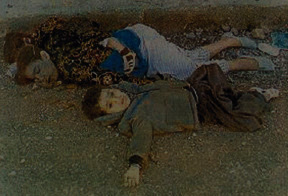
Saddam also used chemical weapons against his own civilian population.
Source. The strongest evidence of Saddam's brutal use of chemical weapons against his own people came during the Anfal campaign. The Anfal campaign has been cited by human rights groups as a campaign of
genocide. It was during the Anfal campaign that Saddam used chemical weapons upon the city of
Halabja. It is reported to be the largest chemical weapon attack on a civilian population in modern times.
Source.
There is no question whether Saddam had weapons of mass destruction. There is no question whether Saddam used weapons of mass destruction. But did Saddam Hussein still have weapons of mass destruction in March of 2003, when the United States launched
Operation Iraqi Freedom? The short answer is yes, but this is a complicated question.
The reason this is such a complicated question is because it has been used to evidence whether or not the United States was justified in going to war with Iraq. In many circles the WMD issue is believed to be the
only reason the United States went to war with Iraq, a myth I have already debunked. The issue has become highly politicized because if Saddam still had WMDs, then Bush was right and he did not lie to the American people.
Let's look back at
the reasons the US government invaded Iraq- specifically to the
legislation which authorized the invasion of Iraq.
Whereas after the liberation of Kuwait in 1991, Iraq entered into a United Nations sponsored cease-fire agreement pursuant to which Iraq unequivocally agreed, among other things, to eliminate its nuclear, biological, and chemical weapons programs and the means to deliver and develop them, and to end its support for international terrorism;
Whereas the efforts of international weapons inspectors, United States intelligence agencies, and Iraqi defectors led to the discovery that Iraq had large stockpiles of chemical weapons and a large scale biological weapons program, and that Iraq had an advanced nuclear weapons development program that was much closer to producing a nuclear weapon than intelligence reporting had previously indicated
In these two paragraphs, with regards to weapons of mass destruction, we see used as justification for invasion Iraq's failure to eliminate its 1) nuclear 2) biological and 3) chemical weapons programs 4)and the means to deliver and 5) develop them. Important for our analysis is also the 6) large stockpiles of chemical weapons.
The first justification for war that we will investigate is Iraq's failure to eliminate its large stockpiles of chemical weapons. The vast majority of media reports about WMDs have focused on the notion that no weapons of mass destruction have been found. Anti-war advocates, the press, and Bush's political opponents all came to the premature conclusion that no WMDs were discovered in Iraq. These groups further postulated that because such a strong case was made in the build up to the 2003 invasion, that Bush and his allies must have fabricated or exaggerated the case made for invasion of Iraq. When
early reports of chemical weapon finds were made (
example 2,
example 3) they were under reported, dismissed by critics, and later denied by the US government.
The critics dismissed these early finds because they were "old" and were being found in small numbers as opposed to "large stockpiles." For instance, from the links provided in the preceding paragraph (emphasis added):
"There is no doubt that the warheads contain chemical weapons," ... "The problem is what period they came from, whether the (Persian) Gulf War or earlier, and whether they were usable, partly usable or not at all."
and:
In May, a booby-trapped artillery shell apparently filled with the sarin nerve agent exploded alongside a Baghdad road but caused no serious injuries to the U.S. forces who discovered it. At the time, officials stopped short of claiming the munition was definite evidence of a large weapons stockpile in prewar Iraq or evidence of recent production by Saddam's regime.
and
The UNMOVIC official said the group needs to know more from the Bush administration before it's possible to determine if this is "old or new stuff". It is known that Iraq used sarin during the Iraq-Iran war, however.
... the shell belonged to a class of ordnance that Saddam's government said was destroyed before the 1991 Gulf war (search). Experts believe both the sarin and mustard gas weapons date back to that time.
It is possible that these early reports were so under-reported because the press wanted absolute confirmation of what was found before they were willing to drop the charges that there were no WMDs and that Bush lied in order to take the United States to war. If they were waiting for such a confirmation, it would explain why these stories were never reported by most of the press. Why? The US government would later come to deny most, if not all, of the early reported finds of WMDs.
Example 1.
Example 2.
Was the United States government being honest when it reported that these early finds were false alarms? We cannot say with any degree of certainty if any of these early reported finds were actually authentic WMD discoveries. It is possible that the government was being honest in denying these few isolated reports.

However, In 2006 at the urging of congress, the executive branch declassified some "key points" from a National Ground Intelligence Center report on the recovery of chemical munitions in Iraq.
The report made public for the first time an acknowledgement by the US government that WMDs had been found in Iraq dating back to 2003. From 2003 to 2006 approximately 500 "degraded" WMDs were recovered in Iraq. This information was classified and kept secret from the American public until July of 2006.
This report also raises some very interesting questions. If the US government had been finding WMDs since the 2003 invasion, why keep quiet amid all of the harsh criticism?

Why classify information that would vindicate the US position in the lead up to the war?
One possible explanation is National Security.
If we look closely at
one of the early reported finds, the national security justification starts to take focus:
Polish troops had been searching for munitions as part of their regular mission in south-central Iraq when they were told by an informant in May that terrorists had made a bid to buy the chemical weapons, which date back to Saddam Hussein's (search) war with Iran in the 1980s, Gen. Marek Dukaczewski told reporters in Warsaw.
"We were mortified by the information that terrorists were looking for these warheads and offered $5,000 apiece," Dukaczewski said. "An attack with such weapons would be hard to imagine. All of our activity was accelerated at appropriating these warheads."
Dukaczewski refused to give any further details about the terrorists or the sellers of the munitions, saying only that his troops thwarted terrorists by purchasing the 17 rockets for a Soviet-era launcher and two mortar rounds containing the nerve agent for an undisclosed sum June 23.
To put it plainly, the US government wasn't the only group searching for Saddam's chemical weapon stockpiles. Moreover they didn't exactly have complete ground control in Iraq. While the US was on a search and destroy mission, terrorist groups were offering top dollar for chemical weapons. It doesn't take a rocket scientist to see why the Bush administration would want to keep quiet about actual WMD finds. If the US government admitted that WMDs were being found all over Iraq and admitted further that these weapons were still extremely lethal, the logical consequence would be that terrorist groups the world over would be scrambling to find the Saddam's WMDs before the US army could destroy them.
The 2006 unclassified memo outlying "key points" from a National Ground Intelligence Center report on the recovery of chemical munitions in Iraq states clearly that not all of Saddam's chemical munitions have been recovered. They are assessed to still exist. Moreover, they still have the potential to be lethal AND we know terrorists and insurgents are actively seeking to acquire them.
For many, the 2006 unclassified memo was proof enough. The smoking gun had been found. Bush was right and his political opponents, the press, and the anti-war crowd were all wrong. But this is still a fairly complicated issue because the WMD issue was falsely deemed the only reason American invaded Iraq.
For some,
old, degraded, war relics were not a proper justification for war. It would be impossible to please everyone. One of the first reported WMD finds was a sarin filled warhead that had been unwittingly turned into an IED. Critics immediately pointed out that this was
only one WMD, and did not represent a
stockpile. As more small caches of WMDs were reported, the critics pointed out that these small finds did not represent the
large stockpiles they claimed were used to justify the invasion. Even today, when we now know that 500 WMDs were recovered from Iraq, critics point out that these WMDs were
leftovers from the Iraq-Iran war, that they were likely
so degraded as to be
harmless. For some, no matter how much evidence is presented, it doesn't meet the ever changing benchmark of what would justify the war in Iraq.
What we now know is this: The US government has recovered approximately 500 chemical munitions and believes there is still more to be found. The critics who say these are "old" WMDs cannot refute that old or not they represent a stockpile which Saddam, and the UN weapons inspectors, failed to destroy in accordance with the cease-fire agreement.
But what about the ongoing weapons programs? Why were no "new" WMDs recovered? Thus far, the US government claims they haven't found any new WMDs. As with the "old" WMDs, there could be strategic reasons for denying their recovery, so the first theory is that they have been recovered and that this is being kept under wraps. A critic of this theory would likely point out that there is no evidence whatsoever to support it AND it requires the belief that the US government is keeping this information from the world. Well, prior to the June 21, 2006 memo, there was no proof that
any WMDs had been found and the US government had kept evidence of the 500 WMDs recovered classified. Unfortunately, this explanation is entirely speculative in nature.

A more popular theory is that Saddam moved his "new" WMDs out of the country, most likely to Syria. This theory has received support from
Iraqi Generals,
Israeli Intelligence,
Former UN Inspectors, and possibly even
Syrian Journalists. The theory has not been ruled out by the US government; however, the US has said repeatedly that they have no evidence of such a transfer. How could Saddam have transferred so much WMD related materials out of the country with the International community looking on? There are many who believe that
Russia played a role in the removal and disbursement of evidence of Saddam's ongoing programs.
In April of 2004, a
chemical bomb attack was foiled by Jordanian Intelligence. The
attack was masterminded by Abu-Musab al-Zarqawi.
Jordanian officials say the arrests occurred after suspected militants entered Jordan from neighboring Syria in at least three vehicles filled with explosives, detonators and raw material to be used in bomb-making.
Source.
Some
believe that since the chemical-bomb was directed by Iraqi al Qaeda terrorist Abu-Musab al-Zarqawi, and that the weapons were believed to have
traveled through Syria, that the chemical weapons components
may have originated in Iraq and been later purchased by the terrorist plotters in Syria.
If, however, "new" WMDs were not recovered in Iraq or moved to neighboring countries, does this mean that Saddam had no ongoing 1) nuclear, 2) biological, or 3) chemical weapons programs, nor 4) the means to deliver and 5)develop them?

With regards to 5) the means to develop WMDs, Saddam definitely had the means to reinstate his WMD programs. In fact, we know for certain that Saddam made inquires as late as 2001 about how long it would take to have the programs up and running.
We also know that Saddam had a tremendous amount of dual-use equipment in Iraq. Saddam was even able to purchase dual-use equipment and chemicals despite UN sanctions:
Iraq had an effective system for the procurement of items that Iraq was not allowed to acquire due to sanctions. ISG found no evidence that this system was used to acquire precursor chemicals in bulk; however documents indicate that dual-use laboratory equipment and chemicals were acquired through this system.
...
Available evidence indicates Iraq destroyed its hidden CW weapons and precursors, but key documentation and dual-use equipment were retained and were later discovered by inspectors.
...
The lack of inspectors allowed further dual-use infrastructure to be developed. The lack of effective monitoring emboldened Saddam and his illicit procurement activities.
...
Reflecting the importance the Regime attached to industrial and scientific progress and aiming to recover from the war with Iran, Baghdad undertook in the mid 1990s a centralized, national effort to coordinate Iraqi industrial activities. By the late 1990s, fueled by resources available through the Oil-for-Food program, that effort underlay a specific initiative aimed at boosting the capabilities of Iraqi pesticide and pharmaceutical industries, including the capability to manufacture dual-use chemicals. Although ISG found no direct evidence linking dual-use chemical production to an active or latent CW program, research and development on types of specific chemicals linked to Iraq’s CW program raises concerns about the legitimacy of Iraq’s chemical plans.
Source.
Dual-use equipment can be used for making relatively harmless materials, such as pesticides, medicine, shampoo, etc., but can also be quickly converted for the purpose of making deadly WMD chemicals. Some of the equipment used in making WMDs has turned up in
foreign junkyards. The UN provided evidence of WMD-related materials turning up in Jordanian and Dutch scrap yards.
The Seventeenth UNMOVIC Quarterly Report from May 28, 2004 stated:
6. The Commission’s experts are conducting an investigation in parallel with the IAEA Iraq Nuclear Verification Office regarding the discovery of items from Iraq that are relevant to the mandates of UNMOVIC and IAEA at a scrapyard in the
Netherlands. In particular, following a visit of IAEA to a scrapyard in Rotterdam to investigate increased radiation readings, it was discovered, through photographs taken at the time, that engines of SA-2 surface-to-air missiles were among the scrap (see figure below). They are the type of engines used in the Al Samoud 2 proscribed missile programme. In addition, a number of items and equipment that may also be relevant to the UNMOVIC mandate were seen among the scrap. The existence of missile engines originating in Iraq among scrap in Europe may affect the accounting of proscribed engines known to have been in Iraq’s possession in March 2003. Both IAEA and UNMOVIC have kept the Security Council informed of this matter.
7. A team of Commission experts visited the site concerned in the Netherlands and examined one missile engine that had been salvaged from the scrap metal process. By comparing the serial production number on the engine with information in the UNMOVIC database, the experts were able to confirm that the engine was one from an SA-2 missile that had been tagged by United Nations inspectors in the past and had not been declared as having been fired. Representatives of the scrapyard company indicated that a number of similar engines (5 to 12) had been seen in the scrapyard in January and February of this year. More engines could have been processed and passed through the yard unnoticed. Company staff confirmed that other items made of stainless steel and other corrosion-resistant metal alloys bearing the inscription “Iraq” or “Baghdad” had been observed in shipments delivered from the Middle East since November 2003. A number of items were examined and sampled on-site by UNMOVIC experts with a portable metal analyser and were determined to be composed of inconel and titanium — both dual-use materials subject to monitoring. Photographs of other materials bearing Arabic script were taken.

8. Despite the active cooperation of the Government of the Netherlands and the company concerned, it was not possible to determine how many other engines and other material previously subject to monitoring in Iraq may have passed through this scrapyard (or others). It should also be noted that the scrapyard that was visited by UNMOVIC deals in high-quality stainless steel. Items and equipment made of dualuse materials subject to the provisions of the monitoring plan may also be coming out of Iraq to other destinations. The Commission is continuing its investigation.
9. In addition, the Commission is aware from comparative analysis of recent satellite imagery that a number of sites previously known to have contained equipment and materials subject to monitoring have been either cleaned out or destroyed. An example of such imagery is provided in the appendix to the present report. It is not known whether such equipment and materials were still present at the sites during the time of coalition action in March and April of 2003. However, it is possible that some of the materials may have been removed from Iraq by looters
of sites and sold as scrap.
The Eighteenth UNMOVIC Quarterly Report from August 27, 2004 stated:
Investigations into scrap material found outside Iraq
3. The Commission has continued its investigation into the discovery of items relevant to its mandate that have been exported from Iraq as scrap metal. At the beginning of June, Commission experts went to Jordan and with the support and cooperation of Jordanian authorities visited a number of trading companies dealing with the export of scrap metal from Iraq to Jordan. They visited scrapyards associated with the respective trading companies and interviewed relevant personnel, including trading company managers, merchants and truck drivers of Jordanian and Iraqi nationality.
4. A significant number of items relevant to the UNMOVIC mandate were observed at the scrapyards. They included 20 SA-2 missile engines, a solid propellant-mixing vessel tagged by UNMOVIC during its 2002-2003 inspection activities in Iraq, fragmented remains of an SA-2 airframe and booster, as well as four chemical-related vessels made of corrosion-resistant material that had been tagged by the Commission as dual-use items. According to information received from the trading company representatives, the tagged chemical vessels had been dismantled from the chemical industrial complex near Fallujah. The Commission’s experts were able to confirm that information by comparing the serial numbers of the United Nations tags still attached to the vessels with information in the UNMOVIC database.
5. During interviews conducted with more than 20 persons involved in the scrap metal trade, it was determined that the first scrap metal started arriving in Jordan from Iraq in June 2003. The flow of stainless steel and other more valuable alloys commenced later in the summer and continued in 2004. A rough estimate made by scrap company managers was that a total of 60,000 tons of Iraqi scrap metal had passed through Jordan’s largest free trade zone in 2003 and an additional 70,000 tons up until June 2004. UNMOVIC experts were told that that amount comprised only a small part of all scrap materials exported from Iraq to the other countries that border Iraq and further to Europe, North Africa and Asia. It was also said that a lot of high-quality industrial production equipment from facilities all over Iraq had been purchased by unnamed contractors at low cost, dismantled and moved out of the country. If correct, this could include equipment subject to monitoring in Iraq.
6. According to some of the merchants, the authorities in Iraq had overall control of the scrap export business. Several sites that were monitored previously by UNMOVIC were mentioned as having been razed. Information on the web site of the Iraqi Ministry of Trade (www.motiraq.org) sets out the licensing and other procedures for the export of scrap. There are seven stipulated border crossings to all of Iraq’s neighbouring countries, via which scrap metals can be exported. The Iraqi port of Umm Qasr is also authorized to trade directly with the rest of the world.
7. Following the visit to Jordan, information was received from the Government of the Netherlands of the discovery in early July by a Rotterdam scrap company of an additional 22 SA-2 missile engines in a shipment from Turkey. The Commission requested the support of the Government of Turkey to facilitate a visit by UNMOVIC experts to a Turkish company believed to be involved in the trading of scrap originating in Iraq.
8. With the cooperation of the Government of Turkey, a team of UNMOVIC and International Atomic Energy Agency (IAEA) experts visited an Istanbul scrapyard in the second half of July 2004. No items of relevance to UNMOVIC were found at the yard of the company. The team was told that the Turkish company only acted as a transit broker for scrap metal originating in Iraq. Turkish customs officials later explained that scrap from Iraq was transported through Turkey under seal to customs clearing yards, where it was loaded into containers for onward shipment to foreign markets. The experts observed the removal of customs tags from one of the trucks arriving from Iraq. While they were not able to witness the unloading of the truck into the container, a cursory examination of the upper layers of the load did not reveal any items related to Iraq’s past weapons programmes or materials subject to monitoring. When questioned, no one recalled seeing any missile engines or other materials relevant to UNMOVIC, but it was stated that it was quite possible that some had passed through Turkey.
9. With the agreement of the relevant Member States, UNMOVIC intends to observe the destruction of the SA-2 missile engines located in Jordan and the Netherlands together with other tagged and dual-use equipment that had been under monitoring in Iraq. All identifying data have been recorded and photographs have been taken.
The mere existence of Iraqi dual-use equipment and chemicals is proof of Saddam's failure to destroy his WMD development capabilities. Additionally, Saddam employed legions of scientists who were experts in the production of WMD related technology. Why keep these scientists on the payroll when you have no intention of ever putting them to use in their area of expertise?
From at least 1999 onward Saddam became increasingly interested in the activities of the IAEC and began holding regular meetings with representatives of the IAEC. Saddam also began to personally intervene in matters related to the IAEC, ranging from internal personnel issues, to prompting other organizations to work with the IAEC and utilize the IAEC’s scientific capabilities. In late 1996, Saddam agreed to the Oil-for-Food program, resulting in significant fund, which he was able to use to bolster his scientific base.
A former scientist at the IAEC spoke of many scientists leaving the IAEC in 1999 because conditions were so poor. The scientist claims that Saddam personally intervened, beginning in 1999, to improve conditions and raise salaries. He also made what the scientist called “a blanket rule” at this time forbidding scientists from leaving their posts.
Dr. Huwaysh recalled that in 2001 and 2002 the frequency of meetings between Saddam and Iraqi nuclear scientists increased. During the same time frame, Saddam also issued a Presidential Order to the President of the IAEC, Dr. Fadil Al-Janabi, that he should keep nuclear scientists together at the IAEC in order to pool their skills and have them available when needed for starting numerous new projects. Dr. Huwaysh did not know the specific details of any of these projects.
Dr. Huwaysh also recalled that, circa 2000, when Saddam found out that former nuclear workers in the IAEC were not being paid as well as those in the MIC, he met with Al-Janabi, initiated raises in their salaries, and instituted a bonus scheme.
A former MIC official stated that, in January 2002, Saddam issued an order requiring the MIC to cooperate with the IAEC and to implement projects in the areas of physics, machining, and electronics.
Saddam also began to take an increased interest in the welfare of former nuclear scientists in the MIC. Dr. Huwaysh stated that in 2000 Saddam began asking about the welfare of former PC-3 scientists within the MIC and referred to them as “my people.” Saddam, a former IAEC Chairman in the mid-1970s, reportedly made it clear that he cared greatly about the former nuclear program and began showing a renewed level of interest in it at this time.
Source.
Dual-use equipment and nuclear scientists were not the only evidence of Iraq's means to develop nuclear, biological, and chemical weapons. There is substantial evidence to prove that Saddam did not abandon his nuclear aspirations.
ISG has uncovered two instances in which scientists linked to Iraq’s pre-1991 uranium enrichment programs kept documentation and technology in anticipation of renewing these efforts—actions that they contend were officially sanctioned.
A former engineer in the pre-1991 EMIS program claimed he was told by the head of MIC in 1997 to continue his work with ion implantation at his Al Tahaddi lab as a way to preserve EMIS technology.
The former head of Iraq’s pre-1991 centrifuge program also retained prohibited documents and components in apparent violation of the Regime’s directives. Though this activity was isolated, it also had the potential to contribute to a possible restart of Iraq’s uranium enrichment programs.
Source.
The "former head" of Iraq's centrifuge program made headlines when he turned over the "prohibited documents and components." For instance:
Nuke program parts unearthed in Baghdad back yard
The parts, with accompanying plans, were unearthed by Iraqi scientist Mahdi Obeidi who had hidden them under a rose bush in his garden 12 years ago under orders from Qusay Hussein and Saddam Hussein's then son-in-law, Hussein Kamel.
U.S. officials emphasized this was not evidence Iraq had a nuclear weapon -- but it was evidence the Iraqis concealed plans to reconstitute their nuclear program as soon as the world was no longer looking.
The parts and documents Obeidi gave the CIA were shown exclusively to CNN at CIA headquarters in Virginia.
Obeidi told CNN the parts of a gas centrifuge system for enriching uranium were part of a highly sophisticated system he was ordered to hide to be ready to rebuild the bomb program.
"I have very important things at my disposal that I have been ordered to have, to keep, and I've kept them, and I don't want this to proliferate, because of its potential consequences if it falls in the hands of tyrants, in the hands of dictators or of terrorists," said Obeidi, who has been taken out of Iraq with the help of the U.S. government.
Obeidi also said he was not the only scientist ordered to hide that type of equipment.
"I think there may be more than three other copies. And I think it is quite important to look at this list so they will not fall into the hands of the wrong people," he said.
Centrifuges are drums or cylinders that spin at high speed and separate heavy and light molecules, allowing increasingly enriched uranium to be drawn off.
More.
It is unclear why this find was not considered to be a smoking gun. An Iraqi scientist was ordered by his government to hide and retain components necessary for producing a nuclear weapon. At the very least, the centrifuge could be used to enrich uranium, which could later be used in a radioactive "dirty bomb."
A great deal of media attention was focused on whether Iraq wanted to purchase natural/yellow cake Uranium from Niger. One piece of evidence would later turn out to be a forged document which alleged a final transaction; however, there was still credible evidence to indicate that Iraq was seeking uranium from Niger.
Consider the argument provided in Christopher Hitchens Slate article,
Wowie Zahawie:
In February 1999, Zahawie left his Vatican office for a few days and paid an official visit to Niger, a country known for absolutely nothing except its vast deposits of uranium ore. It was from Niger that Iraq had originally acquired uranium in 1981....
...
However, the waters have since become muddied, to say the least. For a start, someone produced a fake document, dated July 6, 2000, which purports to show Zahawie's signature and diplomatic seal on an actual agreement for an Iraqi uranium transaction with Niger. Almost everything was wrong with this crude forgery....
...
But this doesn't alter the plain set of established facts.... The European intelligence services, and the Bush administration, only ever asserted that the Iraqi regime had apparently tried to open (or rather, reopen) a yellowcake trade "in Africa." It has never been claimed that an agreement was actually reached. What motive could there be for a forgery that could be instantly detected upon cursory examination?
There seem to be only three possibilities here. Either a) American intelligence concocted the note; b) someone in Italy did so in the hope of gain; or c) it was the product of disinformation, intended to protect Niger and discredit any attention paid to the actual, real-time Zahawie visit.
Read the whole article.
Factcheck.org also had an interesting analysis of the controversy, in which the Butler report is cited:
Butler Report: It is accepted by all parties that Iraqi officials visited Niger in 1999. The British Government had intelligence from several different sources indicating that this visit was for the purpose of acquiring uranium. Since uranium constitutes almost three-quarters of Niger’s exports, the intelligence was credible.
Whether or not Iraq was trying to purchase uranium from Niger was an issue that received an enormous amount of attention from the press. What is truly amazing is how little press was dedicated to that fact that Iraq actually had uranium in its possession when the US invaded in 2003.
After the invasion, at least 1.8 tons of uranium was removed from Iraq by the US government.
U.S. transferred nearly 2 tons of uranium from Iraq to U.S. without U.N. authorization
UNITED NATIONS – The United States didn't have authorization from the U.N. nuclear watchdog when it secretly shipped from Iraq uranium and highly radioactive material that could be used in so-called "dirty bombs," U.N. officials said Wednesday.
The nearly 2 tons of low-enriched uranium and approximately 1,000 highly radioactive items transferred from Iraq to the United States last month had been placed under seal by the International Atomic Energy Agency at the sprawling Tuwaitha nuclear complex, 12 miles south of Baghdad, the officials said.
...
According to the letter, the United States informed the IAEA on June 30 that approximately 1.8 tons of uranium, enriched to a level of 2.6 percent, another 6.6 pounds of low-enriched uranium, and approximately 1,000 highly radioactive sources had been transferred on June 23.
...
In 1992, after the first Gulf War, all highly enriched uranium – which could be used to make nuclear weapons – was shipped from Iraq to Russia, the IAEA's Zlauvinen said.
After 1992, roughly 2 tons of natural uranium, or yellow cake, some low enriched uranium and some depleted uranium was left at Tuwaitha under IAEA seal and control, he said.
...
IAEA inspectors left Iraq just before last year's U.S.-led war. After it ended, Washington barred U.N. weapons inspectors from returning, deploying U.S. teams instead in a so far unsuccessful search for Iraqi weapons of mass destruction.
...
ElBaradei's letter said that an unspecified amount of nuclear material still at Tuwaitha consists mainly of natural uranium, some depleted uranium and some low enriched uranium waste, which is subject to IAEA monitoring.
Read the full article.
The UN left nearly 2 tons of yellow cake uranium, a small amount of "low enriched" uranium, and an undisclosed amount of
depleted uranium in Iraq. Then Saddam threw the UN out of Iraq, effectively putting the Uranium back in his possession.
In summation, we know that Saddam had strong nuclear aspirations. In the early 90's, Saddam was as close as one year away from creating a nuclear weapon. We know that while Saddam did apparently suspend these programs, he never fully abandoned his nuclear programs. Saddam kept nuclear scientists on his payroll, and ordered them not to leave. Iraqi scientists hid documents and equipment used in making nuclear weapons with the intent of reinstating the nuclear weapons programs. Additionally, Saddam had in his possession nearly two tons of yellow cake uranium, which was originally purchased from Niger, and Saddam was suspected of wanting to purchase additional uranium - a suspicion supported by a 1999 trip by Iraqi diplomats to Niger.
Dual use equipment, scientists capable of creating WMDs - including nuclear bombs, a nuclear centrifuge, and nearly two tons of uranium are not the only evidence of Saddam's capability to develop WMDs. Large chemical caches and chemical weapons factories have been found in Iraq.
For instance:
Iraq Raid Yields Possible Chemical Production Facility
WASHINGTON, Aug. 13, 2005 – Acting on detainee-provided tips, coalition forces found what's believed to be an insurgent chemical production facility and chemical storage locations during Aug. 9 raids in northern Iraq, officials in Iraq reported today
This article gives some additional information on the find:
Alleged chemical weapons factory uncovered in Iraq
August 14, 2005
BAGHDAD -- US troops raiding a warehouse in the northern city of Mosul uncovered a suspected chemical weapons factory containing 1,500 gallons of chemicals believed destined for attacks on US and Iraqi forces and civilians, military officials said yesterday.
The early morning raid last Monday found 11 precursor agents, "some of them quite dangerous by themselves," a military spokesman, Lieutenant Colonel Steven Boylan,  said in Baghdad.
Combined, the chemicals would yield an agent capable of "lingering hazards" for those exposed to it, Boylan said. The likely targets would have been "coalition and Iraqi security forces, and Iraqi civilians," partly because the chemicals would be difficult to keep from spreading over a wide area, he said.
This was not the only chemical lab discovered in Iraq:
Iraqi forces find chemical materials in lab
Iraqi soldiers have discovered chemical materials in a Falluja lab....
...
Iraq's interim National Security Adviser Kasim Dawood announced discovery of the lab with chemical materials which he said was "manufacturing death, intoxication and assassination."
"We have also discovered in this laboratory a pamphlet and instructions showing how to manufacture explosives and toxins," Dawood said. "And they also talk about the production of anthrax."
Critics of these finds are quick to point out that the labs were "new," having been established after the US invasion in 2003. Critics have claimed that Saddam had no ongoing weapons programs, but because of US
interference in Iraq, more terrorists are being
made and that they are the ones behind the chemical labs. Critics claim the attempt to make the world safer by removing Saddam has failed and continued attempts to wage war on terror will bring similar consequences. This assertion walks a fine line between delusion and utter madness. More importantly, this line of thinking overlooks some important facts: Chemical weapons labs require 1) chemicals and 2) equipment. Just because a chemicals weapon lab sprouts up in a new location does not mean that contents of the lab are new.
Terrorists and insurgents in Iraq could not create chemical weapon labs without access to chemicals and the equipment necessary for converting these chemicals into weapons. But how did the terrorists acquire chemicals, in one instance 1,500 gallons plus the equipment for making chemical weapons in Iraq? This would be a very difficult question to answer, unless of course Saddam had chemicals and equipment for weaponizing these chemicals scattered across Iraq. We already know that terrorists were offering
$5,000 per warhead, for chemical warheads. Reports of looting across Iraq is common knowledge. Additionally, the UN has reported that satellite surveillance of monitored sites have shown entire buildings including all of their contents have disappeared. It doesn't require much of a stretch of the imagination to wonder if the terrorists and insurgents in Iraq acquired the chemicals and equipment through purchase or looting of former Iraqi sites.


If Saddam had destroyed his WMD capabilities, this problem could not exist.
With regards to 4) the means to deliver nuclear, biological, and chemical weapons, Saddam clearly had ongoing programs which violated UN sanctions and the ceasefire between Iraq and the United States. This information has been reported
in the press since prior to the Iraq invasion.
GlobalSecurity.org has an excellent article on the Al Samoud, which contains the following:
In February 2003, U.N. inspectors evaluated two versions of the Al Samoud 2 missile using four separate computer models. Both versions were found to exceed the range limit of 150 kilometers set by the U.N. Security Council. The lighter version of the Al Samoud 2 was estimated to have a range of 193 kilometers, while the heavier version would be capable of a 162 km range. Accordingly, it was requested that all Al Samoud 2 missiles and warheads be delivered to the inspectors for destruction.
The Al Samoud was not the only missile Iraq was developing in violation of the cease-fire agreement.
Despite the limitations imposed by the UN sanctions and the international arms embargo, Iraq was able to produce and field the domestically designed Al Fat’h composite solid-propellant ballistic missile. The goal of the program, which commenced in June 1997, was to develop a missile that could deliver a 300-kg payload to a range of 150 km with an accuracy of 150 meters Circular Error Probable (CEP). The accuracy requirement for an unguided version of the Al Fat’h was 750 meters CEP. The Al Fat'h program began under the Ababil-100 project in the early 1990s. By 1994 the liquid- and solid-propellant missile development programs under Ababil-100 had split, and the solid-propellant program retained the Ababil-100 name. The Iraq Survey Group (ISG) concluded that the Al Fat'h was used with a unitary High Explosive (HE) warhead or a Submunition warhead, and was not intended for Chemical or Biological Weapon (CBW) use.
Source.
Prior to the war 2003 invasion of Iraq, the UN uncovered the smoking gun with regards to Saddam's ongoing program to develop the means to deliver WMDs. The discovery of Saddam's Al Samoud 2 and Al Fatah were proof of an ongoing weapons program in violation of UN restrictions. The Iraq survey group would later declare that the warheads were merely fitted with a "high-explosive (HE) warhead" and that there was no evidence that the Iraqi government had "considered or designed bulk-filled CBW warheads for the Al Samud." However, the Iraq survey group also stated:
Although ISG has recovered no evidence to suggest that “special” warheads were developed for the Al Samuds, the warhead is a direct extrapolation of the impact warhead design for the Scud and Al Husayn missiles and could be modified in the same way Iraq modified the Al Husayn HE warhead to produce crude CBW warheads.
Iraq retained the intellectual capital for reproducing these kinds of “special” warhead designs, so modification and production of this crude type of warhead could be achieved in a matter of weeks with a relatively small team of specialized individuals.
Simply put, in the matter of a few weeks Saddam could modify the Al Samoud and the Al Fatah to carry a chemical or biological warhead using the exact same methods he used to modify previous missiles in order to create WMDs.
With regards to the myth that no WMDs were found: 500 chemical weapons, a nuclear centrifuge and nuclear weapon documents, 1.8 tons of uranium, 2 ongoing illegal missile programs capable of being converted for use with WMDs, enough dual-use equipment to reinstitute WMD production within weeks, and experienced scientists capable of making WMDs on the government payroll have all been found in Iraq. We don't know if Saddam's WMD programs manufactured "new" WMDs between 1996 and 2003, but we do know that he kept his programs in place, that he continued to acquire components which could be used in his weapons programs, and that he did not destroy his chemical weapon caches.
None of this information that I have acquired exclusively through internet research(including the ISG report, UNMOVIC reports, and mainstream news articles) is secret, hard to find, or otherwise unavailable to anyone, least of all investigative journalists. Nevertheless "investigative journalists" continue to print "No WMDs have been found in Iraq." It is false, wrong, misleading, and calculated. The next time you hear someone say, "but no WMDs were found" you will know better; and hopefully you will speak up.




 Barack Obama


